



V1b Receptor
V1b receptor (AVPR1B) is a G protein-coupled vasopressin receptor through which arginine vasopressin modulates the hypothalamic-pituitary-adrenal axis under stress[1]. Mechanistically, AVP from the hypothalamic paraventricular nucleus acts on V1b receptors in anterior pituitary corticotrophs to augment corticotropin-releasing hormone-driven ACTH release[2]. In acute restraint and forced-swim stress models, Avpr1b knockout or antagonist treatment reduces stress-induced ACTH responses, supporting its use in HPA-axis research models[2]. Compared with related isoforms, rat supraoptic neurons express V1a and V1b, but not V2, receptor transcripts, indicating isoform-specific hypothalamic receptor distribution[3]. Human pharmacology studies show d[Cha⁴]AVP has high potency and selectivity at hV1b, whereas SSR149415 also antagonizes oxytocin receptors[4]. For experimental applications, V1B-30N acts as a potent selective V1b receptor antagonist and reduces anxiety-like separation vocalization without sedation in rodent pups[5]. Clinical research links AVPR1B variation with childhood-onset mood disorders and identifies TS-121 as a V1B antagonist tested as adjunctive therapy in major depressive disorder[1][6].- V1b receptor signaling links vasopressin to ACTH release and stress-axis activation[1][2].- Isoform comparison separates V1b research from V1a neural and V2 renal contexts[3].- Selective agonists and antagonists support mechanistic studies in stress and affective models[4][5][6].
References:
- [1]. Dempster EL, et al. Evidence of an association between the vasopressin V1b receptor gene (AVPR1B) and childhood-onset mood disorders. Arch Gen Psychiatry. 2007 Oct;64(10):1189-95. [Content Brief]
- [2]. Roper JA, et al. Attenuated stress response to acute restraint and forced swimming stress in arginine vasopressin 1b receptor subtype (Avpr1b) receptor knockout mice and wild-type mice treated with a novel Avpr1b receptor antagonist. J Neuroendocrinol. 2010 Nov;22(11):1173-80. [Content Brief]
- [3]. Piao G, et al. Ion-Enhanced Conversion of CO2 into Formate on Porous Dendritic Bismuth Electrodes with High Efficiency and Durability. ChemSusChem. 2020 Feb 21;13(4):698-706. [Content Brief]
- [4]. Griffante C, et al. Selectivity of d[Cha4]AVP and SSR149415 at human vasopressin and oxytocin receptors: evidence that SSR149415 is a mixed vasopressin V1b/oxytocin receptor antagonist. Br J Pharmacol. 2005 Nov;146(5):744-51. [Content Brief]
- [5]. Hodgson RA, et al. Characterization of a novel vasopressin V1b receptor antagonist, V1B-30N, in animal models of anxiety-like and depression-like behavior. Eur J Pharmacol. 2014 May 5;730:157-63. [Content Brief]
- [6]. Kamiya M, et al. Efficacy and safety of TS-121, a novel vasopressin V1B receptor antagonist, as adjunctive treatment for patients with major depressive disorder: A randomized, double-blind, placebo-controlled study. J Psychiatr Res. 2020 Sep;128:43-51. [Content Brief]
-
V1b Receptor Related Products (11)
Related Products (11)

- 1
-
Terlipressin diacetate
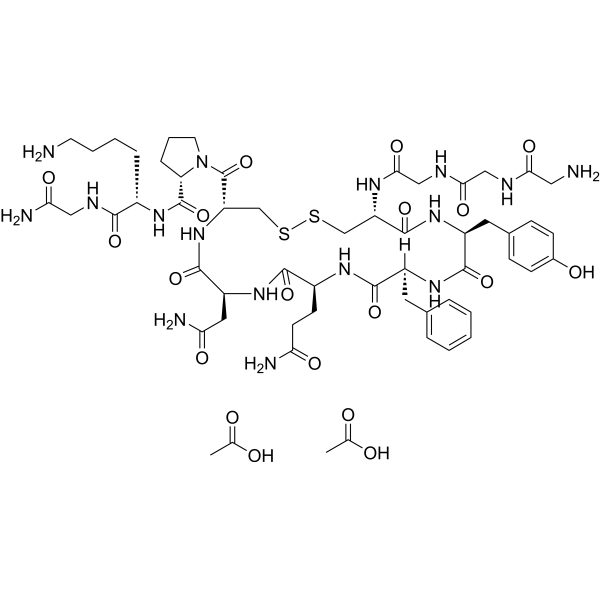 0 ImagesTerlipressin diacetate is a vasopressin analogue with potent vasoactive properties. Terlipressin diacetate is a highly selective vasopressin V1 receptor agonist that reduces the splanchnic blood flow and portal pressure and controls acute variceal bleeding. Terlipressin diacetate exerts anti-inflammatory and anti-oxidative effects. Terlipressin diacetate has the potential for hepatorenal syndrome and norepinephrine-resistant septic shock research.
-
D[LEU4,LYS8]-VP TFA
![D[LEU4,LYS8]-VP TFA](https://file.medchemexpress.com/product_pic/hy-p1163a.gif "Click to View D[LEU4,LYS8]-VP TFA Product Detail") 0 ImagesCat. No.: HY-P1163APurity: 98.97%D[LEU4,LYS8]-VP TFA is a selective agonist of vasopressin V1b receptor, with the Kis of 0.16 nM, 0.52 nM, and 0.1.38 nM for rat, human and mouse V1b receptor, respectively. D[LEU4,LYS8]-VP TFA has weak antidiuretic, vasopressor, and in vitro oxytocic activities.
0 ImagesCat. No.: HY-P1163APurity: 98.97%D[LEU4,LYS8]-VP TFA is a selective agonist of vasopressin V1b receptor, with the Kis of 0.16 nM, 0.52 nM, and 0.1.38 nM for rat, human and mouse V1b receptor, respectively. D[LEU4,LYS8]-VP TFA has weak antidiuretic, vasopressor, and in vitro oxytocic activities.
-
d[Cha4]-AVP
![d[Cha4]-AVP](https://file.medchemexpress.com/product_pic/hy-p1390.gif "Click to View d[Cha4]-AVP Product Detail") 0 Imagesd[Cha4]-AVP is a potent and selective vasopressin (AVP) V1b receptor agonist with a Ki of 1.2 nM for human V1b receptor. d[Cha4]-AVP shows more selective for V1b receptor than human V1a receptor, V2 receptor, and oxytocin receptors.
0 Imagesd[Cha4]-AVP is a potent and selective vasopressin (AVP) V1b receptor agonist with a Ki of 1.2 nM for human V1b receptor. d[Cha4]-AVP shows more selective for V1b receptor than human V1a receptor, V2 receptor, and oxytocin receptors.
-
Fuscoside
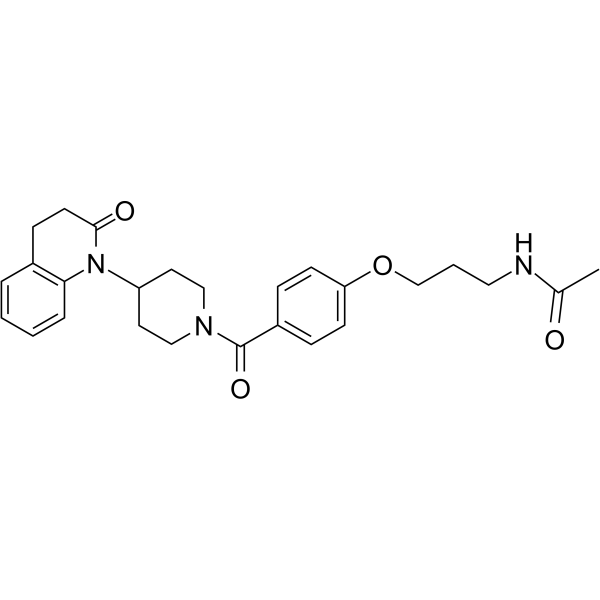 0 ImagesSynonyms: OPC-21268Fuscoside (OPC-21268) is an orally effective, nonpeptide, vasopressin V1 receptor antagonist with an IC50 of 0.4 μM.
-
TASP0390325
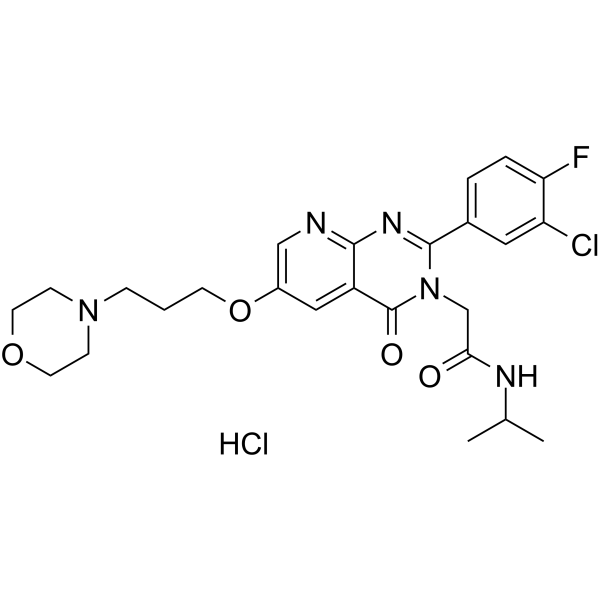 0 ImagesTASP0390325 is a high affinity and orally active arginine vasopressin receptor 1B (V1B receptor) antagonist with antidepressant and anxiolytic activities.
-
Vasopressin Dimer (parallel) TFA
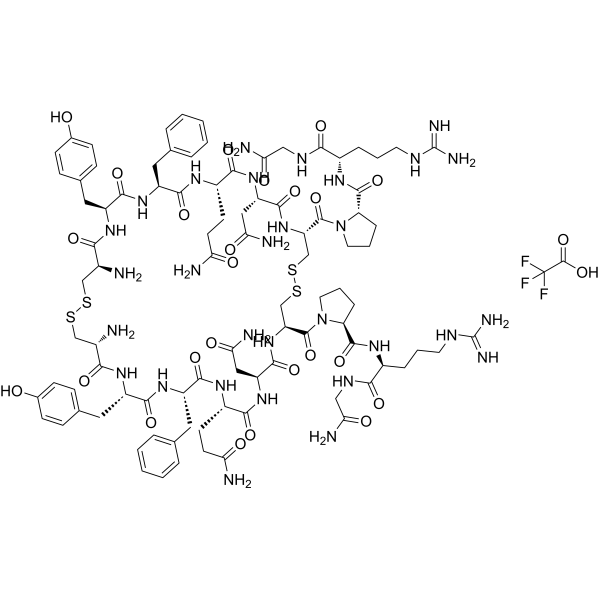 0 ImagesCat. No.: HY-P5213Purity: 99.55%Vasopressin Dimer (parallel) TFA is a parallel dimer of Vasopressin (HY-B1811). Vasopressin Dimer (parallel) TFA can activate four G protein-coupled receptors, V1aR, V1bR, V2R, and OTR.
![d[Cha4]-AVP TFA](https://file.medchemexpress.com/product_pic/hy-p1390a.gif "Click to View d[Cha4]-AVP TFA Product Detail")
-
Vasopressin Dimer (anti-parallel) TFA
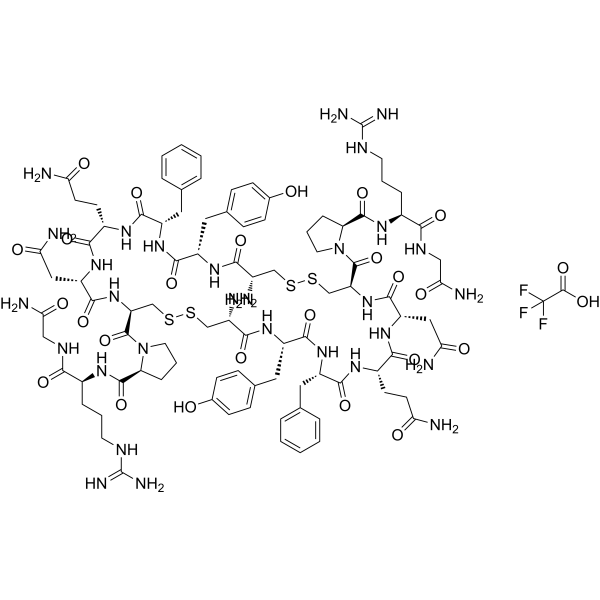 0 ImagesCat. No.: HY-P5214Vasopressin Dimer (anti-parallel) TFA is an anti-parallel dimer of Vasopressin (HY-B1811). Vasopressin Dimer (anti-parallel) TFA can activate four G protein-coupled receptors, V1aR, V1bR, V2R, and OTR.
-
V1b Receptor antagonist-1
 0 ImagesCat. No.: HY-178573CAS No.: 1056550-56-1V1b receptor antagonist-1 is a potent, selective and brain-penetrant vasopressin 1b (V1b) receptor antagonist. V1b receptor antagonist-1 exhibits anti-depressant activity. V1b receptor antagonist-1 can be used for the research of neurological disease, such as depression.
-
YM218 free base
 0 ImagesCat. No.: HY-118918CAS No.: 387816-81-1YM218 free base is an orally active non-peptide vasopressin (AVP) receptor antagonist. YM218 free base has a high affinity for rat liver V1A receptors with a Ki value of 0.50 nM; it has a lower affinity for rat pituitary V1B, kidney V2, and uterine oxytocin receptors with Ki values of 1510 nM, 72.2 nM, and 150 nM, respectively. YM218 free base can be used in the study of diabetes and kidney disease.
-
TASP0434299
 0 ImagesCat. No.: HY-120247CAS No.: 1520893-08-6TASP0434299 (Compound 10) is a labeled ligand for the vasopressin V1b receptor. TASP0434299 exhibits high binding affinity for human and murine V1B receptors, with IC50 values of 0.526 nM and 0.641 nM, respectively, and shows potent antagonistic activity against the human V1B receptor with an IC50 of 0.639 nM. TASP0434299 is a substrate for human and rhesus monkey P-glycoprotein, resulting in low brain uptake in rhesus monkeys. TASP0434299 binds to V1B receptors in rat and monkey pituitary tissues in a saturable and specific manner both in vitro and in vivo. When radiolabeled with tritium or 11C, TASP0434299 serves as a prototype V1B receptor radiotracer to visualize V1B receptor in the pituitary gland of anesthetized monkeys via positron emission tomography.
- 1



